logo
search-icon
News

2027 Mitsubishi Pajero in the UAE: Price, Specs and the Engineering Behind the Return

Martin Victor Alva10 min read
Share

The 2027 Pajero has no announced UAE price. What is known: the projected bracket, the ladder frame, S-AWC, a 480 Nm 2.4 diesel and a fiscal 2027 arrival.

2027 Mitsubishi Pajero in the UAE: Price, Specs and the Engineering Behind the Return: cover image

The 2027 Pajero, fifth of the line, abandons the monocoque shell for a separate ladder frame, swaps the independent rear end for a coil-sprung five-link live axle, and pairs Super Select 4WD-II with Lancer Evolution derived S-AWC torque vectoring. One powertrain was shown: a 480 Nm 2.4-litre turbo-diesel.

Advertisement
MeasureFigureWhat it governs
UAE priceNot announcedThe one figure that decides your budget, and Mitsubishi has not published it
Projected bracketAED 190,000 to AED 260,000A projection rather than a price. Test it against the price list when that appears
Mitsubishi's UAE importerAl Habtoor MotorsWho to ask for the price list, the first service costs and your nearest workshop
Middle East arrivalThrough fiscal 2027When you can drive one rather than read about one
PlatformSeparate ladder frame, five-link live axleHow it carries a load and what it does to ride on a broken surface
DrivelineSuper Select 4WD-II with S-AWCWhether you can stay in four-wheel drive on tarmac between the dunes
Engine shown2.4-litre turbo-diesel, 480 NmPulling away loaded, towing, and low-speed work in sand

Quick Answer

Twelve Dakar Rally victories sit behind this badge, including an unbroken run from 2001 to 2007, and the nameplate went quiet after the fourth-generation V80 ended production. What Mitsubishi showed in Tokyo is not a styling revival. The platform, the driveline electronics and the powertrain architecture have all been reworked, and in one significant respect the engineering has been deliberately reversed.

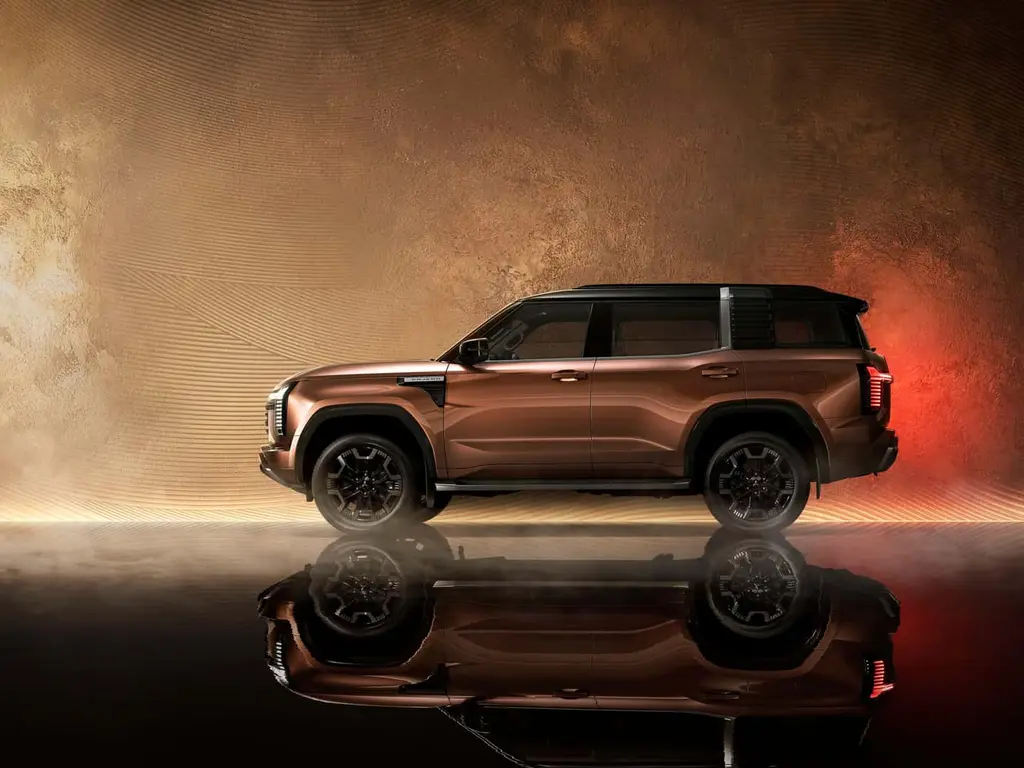
The fifth-generation Mitsubishi Pajero

The platform reversal

In 1999 the third-generation V60 moved to a monocoque shell with an integrated ladder frame and four-wheel independent suspension, double wishbone at the front and multi-link at the rear. That bought torsional stiffness and composure on fast gravel. It cost suspension travel, flexibility in lift geometry and cross-axle articulation at the extremes.

The fifth generation goes the other way. The unibody is gone in favour of a separate heavy-duty ladder frame with a significantly expanded cross-section and a higher proportion of ultra-high-tensile steel.

At the front, independent double wishbones run extended-travel coil springs and a hollow anti-roll bar. At the rear, the independent multi-link setup has been replaced by a newly developed five-link rigid live axle on coils. The practical effect is more droop on off-camber ground and none of the camber change that a heavily loaded independent rear shows.

Advertisement
MeasureFigureWhat it governs
Wheelbase2,870 mmBreakover clearance and stability at speed
Length x width x height4,920 x 1,925 x 1,910 mmParking footprint and garage height
Track, front and rear1,630 mmWhether it follows an existing set of ruts
Ground clearance230 mm on 20-inch alloysWhat it clears before the underbody does the clearing
Approach / breakover / departure30.4 deg / 22.6 deg / 25.8 degThe angles at a dune crest and a wadi lip
Weight distribution52:48 front to rearHow it behaves as the rear unloads
Brakes18-inch ventilated discs, multi-piston calipersRepeated stops on a long descent

Driveline: Super Select 4WD-II meets S-AWC

The transfer case architecture survives with its four modes intact. 2H drives the rear axle alone and disconnects the front to remove driveline drag on the highway. 4H is full-time four-wheel drive through an open planetary centre differential with a 40:60 default split, variable to 50:50 through an electronically controlled viscous coupling. 4HLc locks that centre differential to a mechanical 50:50 for sand, silt and gravel. 4LLc adds low-range reduction for crawling.

What is new is the company it keeps. For the first time on a ladder-frame Pajero, SS4-II is paired with Super All Wheel Control, the system Mitsubishi developed on the Lancer Evolution.

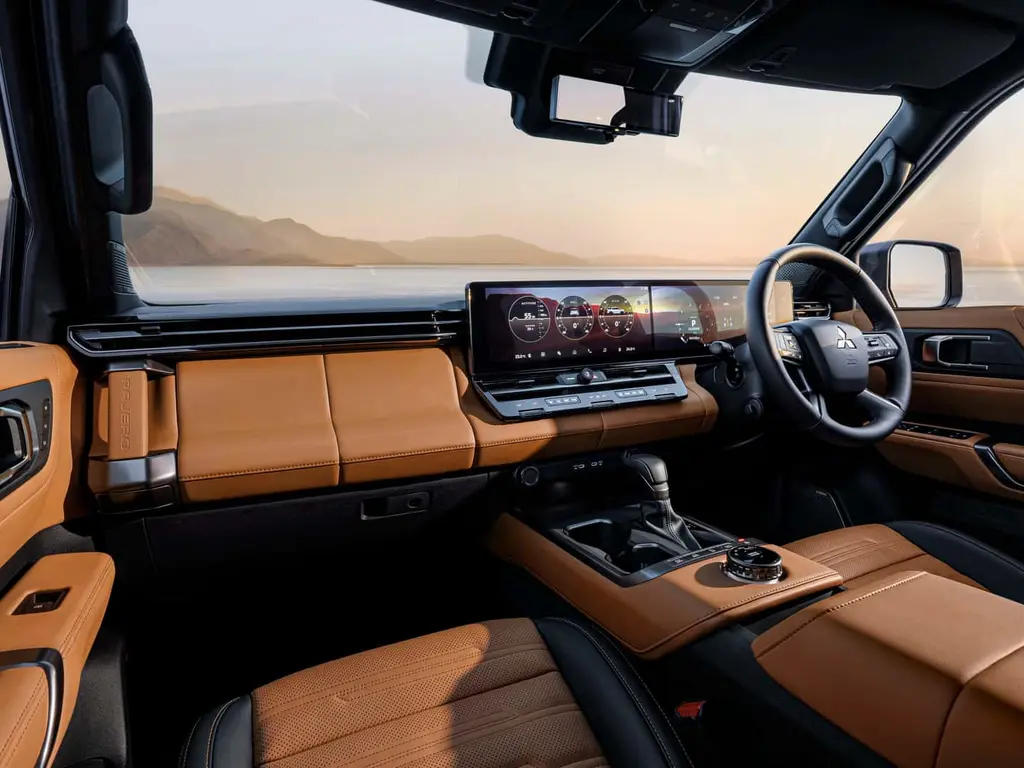
Pajero interior and cabin architecture

Active Yaw Control applies micro-pulses through the electric brake booster at individual inside wheels to induce a yaw moment, countering understeer under power and vectoring drive across open differentials. Active Stability and Traction Control samples steering angle, wheel speed and longitudinal and lateral G-sensors over the CAN bus.

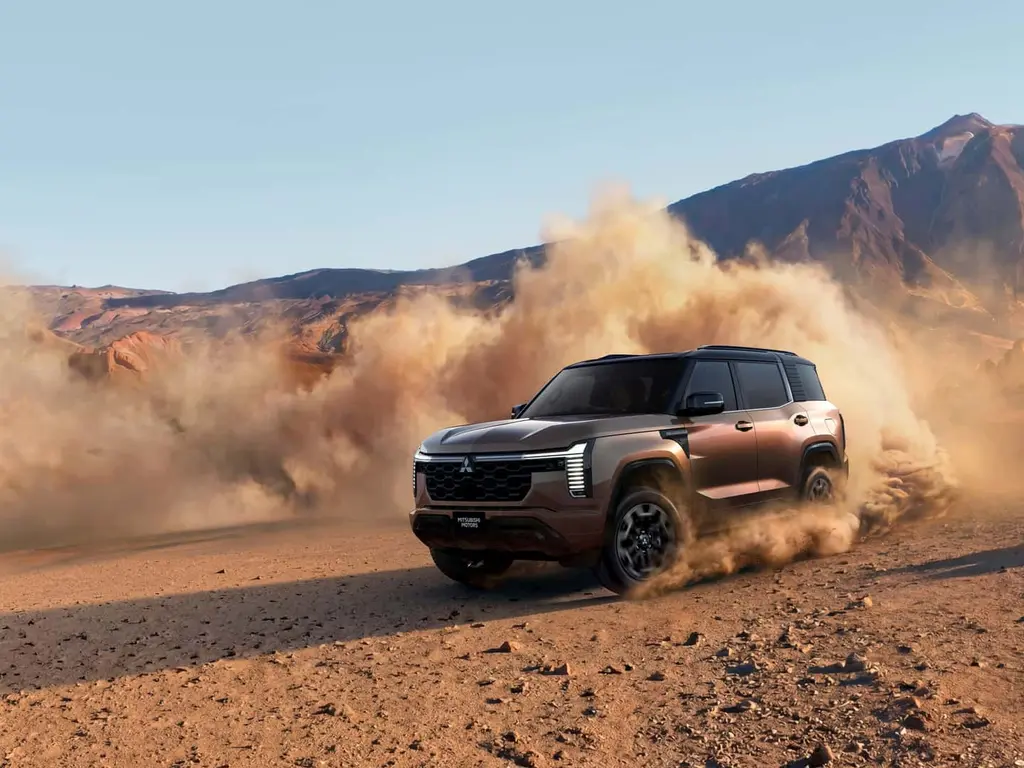
Seven terrain modes sit on top: Normal, Eco, Gravel, Snow, Mud, Sand and Rock. Sand is the one that matters most here. It alters throttle gain, delays upshifts and relaxes traction-control intervention, because a system that cuts power the instant a wheel spins is a system that digs you into a soft slipface.

The powertrain, and the one that is not there

Tokyo showed a single engine: a 2.4-litre clean turbo-diesel tuned for low-rpm response, with peak torque of 480 Nm. It uses a single wide-range variable-geometry turbocharger rather than a sequential bi-turbo, trading peak figures at high rpm for boost response low down and durability at high ambient temperatures, which is the trade that matters in this region.

It drives through a newly developed eight-speed torque-converter automatic with a Sport mode and paddle override, replacing the six-speed used in the Triton. The wider spread lowers the first-gear crawl ratio and drops cruising revs in eighth.

The naturally aspirated 3.5 and 3.8-litre 6G75 V6 petrol engines are not part of this platform. Emissions and fleet-average targets decided that. Instead the frame rails and transmission tunnel were designed from the outset for longitudinal electrification, and Mitsubishi's roadmap points to a longitudinal petrol plug-in hybrid for petrol-dominant markets including the GCC: a downsized turbocharged four-cylinder with high-output motors on both axles. Electric torque arrives at zero rpm, which is a useful property on a steep dune ascent.

Cabin and telemetry

Pajero on desert terrain

Two 14.3-inch displays sit side by side. The driver's cluster revives the old Multi-Meter triple gauges as digital renders, feeding pitch angle, roll gradient, barometric altitude, compass heading, ambient temperature and the live AYC torque split across both axles.

The 3D Multi-Around Monitor processes four cameras into a 360-degree composite at around 30 frames per second, and buffers ground imagery to render a see-through bonnet, putting rocks, blind crests and front tyre positions on the centre screen.

Acoustic laminate is applied to the windscreen and all four door windows. Tri-zone climate control, a 12-speaker Yamaha Dynamic Sound Ultimate system, and Mitsubishi's first front-centre airbag between the two front occupants complete the cabin.

Where and when

Assembly is at Laem Chabang in Thailand. The rollout starts in Thailand, then Australia and Japan before fiscal 2026 closes on 31 March 2027, with Middle East, Latin American and ASEAN distribution through fiscal 2027 across roughly 100 countries.

UAE pricing has not been announced. A bracket of AED 190,000 to AED 260,000 has been projected, but a projection is not a price and Mitsubishi has published no figure. Treat it as an expectation to test against the price list when it appears, not as a number to budget against.

Positioned in that bracket, the Pajero lands in the same part of the market as the ladder-frame Toyota Land Cruiser Prado. The two take different routes to it: Toyota's is a TNGA-F platform with full-time four-wheel drive, Mitsubishi's is a driveline that can decouple its front axle, an Evo-derived vectoring system and a coil-sprung live rear axle.

What This Means for UAE Drivers

Heat. The single variable-geometry turbo instead of a sequential bi-turbo is the choice that reads differently here than it does in Europe. Sequential setups chase peak output; one wide-range VGT is the simpler thermal problem when ambient temperatures sit above 45 degrees and the vehicle is working hard at low road speed, which is what dune driving is. Mitsubishi has published no cooling-system figures, so judge the air conditioning the way you would judge any car here: sit in it on an August afternoon and time how long the cabin takes to cool, not how quickly it cools in a showroom.

Sand, and what the electronics do. The Sand terrain mode relaxes traction-control intervention on purpose. A system tuned for tarmac cuts torque the moment a wheel slips, and on a soft slipface that is precisely how a vehicle digs itself in. The same applies to the 4HLc setting: a locked 50:50 centre differential is the one you want in silt, and the front-axle disconnect in 2H is a highway feature, not a desert one. None of that substitutes for lowering tyre pressures, carrying recovery gear and not driving alone.

Test and modification compliance. Anything fitted after delivery is subject to the same rules as any other vehicle here. Window tint is capped at 50 per cent with no windscreen tint beyond a 15 cm sunstrip, and the penalty is an AED 1,500 fine. A suspension lift over two inches, an exhaust change, a powertrain change or a colour wrap all need prior approval, and unapproved work is a registration problem rather than a matter of taste. The annual vehicle test applies from year three, at AED 170 including fees.

Who imports it. Mitsubishi in the UAE is handled by Al Habtoor Motors. Before you commit to any new nameplate, find where your nearest authorised workshop is and ask what the first three services cost and what the GCC warranty covers in writing. That is worth doing for every car ever sold, and it is worth doing before a launch rather than after one.

Frequently Asked Questions

Does the new Pajero still use a monocoque body?

No. The fifth generation drops the monocoque shell that the third and fourth generations used and returns to a separate heavy-duty ladder frame, with an expanded cross-section and more ultra-high-tensile steel. The rear suspension changes with it, from independent multi-link to a five-link rigid live axle on coil springs.

What engine does the new Mitsubishi Pajero have?

Mitsubishi showed one powertrain at the Tokyo reveal: a 2.4-litre turbo-diesel producing 480 Nm of torque, driving through a new eight-speed torque-converter automatic. It uses a single variable-geometry turbocharger rather than a sequential bi-turbo, which favours low-rpm response and heat durability.

Will there be a petrol Pajero in the UAE?

The 3.5 and 3.8-litre V6 petrol engines are not part of this platform. The chassis was designed for longitudinal electrification, and Mitsubishi's roadmap points to a petrol plug-in hybrid for petrol-dominant markets including the GCC, pairing a downsized turbo four with motors on both axles.

How much will the new Pajero cost in the UAE?

Mitsubishi has not announced UAE pricing. A bracket of AED 190,000 to AED 260,000 has been projected, but that is a projection rather than a published price. Wait for the official price list before budgeting.

Advertisement

When does the new Pajero reach the Middle East?

Production begins at Laem Chabang in Thailand, with the domestic Thai launch first, then Australia and Japan before 31 March 2027. Middle East distribution follows through fiscal 2027, as part of a rollout covering roughly 100 countries.

Martin Victor Alva

Published by

Martin Victor Alva

Founder & Editor-in-Chief

Martin Victor Alva is an automotive strategist, technical writer, and platform founder based in Dubai, UAE. Bringing direct digital transformation and brand strategy experience across leading OEM and distributor portfolios, including Mercedes-Benz, Audi, General Motors Middle East (Chevrolet, Cadillac), Al Futtaim, Toyota, Lexus, Alfa Romeo, Isuzu and more. Martin delivers authoritative perspectives on vehicle engineering, market dynamics, and regional mobility. Since August 2022, he has authored over 1,600 in-depth guides, technical breakdowns, and industry analyses, combining executive-level automotive expertise with hands-on mechanical validation to provide readers with verified, trustworthy insights.

Write your Comment

No comments yet. Be the first to comment!

Related Articles

No articles available
Advertisement

Loading articles...