

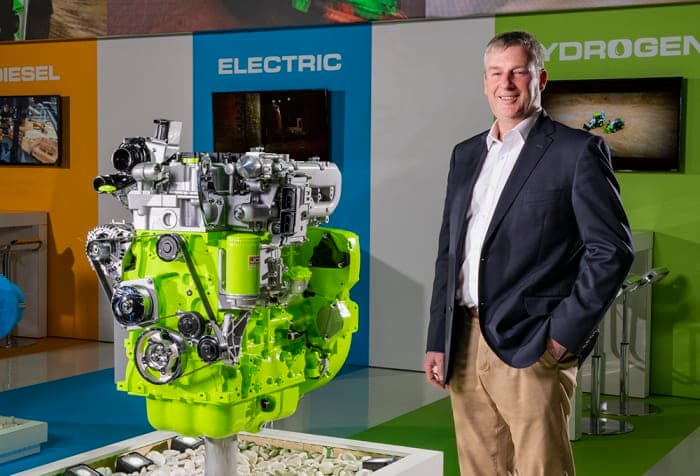
JCB has built a hydrogen engine that is not a fuel cell. The 448 H2 is a 4.8-litre piston engine with a diesel bottom end and spark plugs where the injectors were, and JCB says it matches the torque and power curves of the diesel it replaces.
Quick Answer
Three things make this different from the hydrogen most people have read about. It burns fuel rather than converting it, so there is no fuel cell and no traction motor. It keeps the diesel block, crankshaft and pistons. And its exhaust is water vapour rather than carbon dioxide.
| Measure | JCB 448 H2 | What it governs |
|---|---|---|
| Displacement | 4.8 litres | The size of engine it can replace without redesigning the machine around it |
| Ignition | Spark, with port-injected hydrogen | Why it sounds like a large petrol engine rather than a diesel |
| Bottom end | Carried over from the 448 diesel | Whether it survives the load cycles a working machine puts through it |
| Output | JCB says it matches the diesel's torque and power curves | Whether an operator notices any difference on the job |
| Tailpipe carbon | None | The reason the engine exists |
What JCB Actually Built
The distinction that matters is between combustion and conversion. A fuel-cell vehicle such as the Toyota Mirai uses hydrogen to generate electricity and drives the wheels with an electric motor. The 448 H2 does none of that. Hydrogen enters through port injectors into the intake runners, mixes with air, is compressed, and is lit by a spark plug. It is an internal combustion engine in every mechanical sense.
The design is a hybrid of two engine traditions. The block, crankshaft and pistons come from JCB's existing 448 diesel, which is what gives it the bottom-end strength heavy machinery asks for. The top end is petrol practice: hydrogen has a wide flammability range and a high auto-ignition temperature, so compression ignition is the wrong tool and a spark plug is the right one.
Two consequences follow from spark ignition rather than compression. The combustion event is a progressive flame front rather than the near-instant pressure rise of a diesel, which is why JCB describes the engine as sounding like a large petrol unit. And because the engine runs a high air-to-fuel ratio, peak combustion temperatures stay lower than a diesel's.
That last point is the answer to the obvious objection. Burning anything in air can form nitrogen oxides, because at high enough temperatures atmospheric nitrogen and oxygen combine. JCB's approach is ultra-lean combustion, holding the peak temperature below the threshold where that reaction runs. JCB reports that in its testing the exhaust carries less NOx than the ambient air in a typical urban environment. That is the company's own measurement, and we hold no independent figures for it.
The Land-Speed Run
To load the platform harder than a job site would, JCB built a streamliner called the HydroMax around two modified 5.0-litre twin-turbocharged hydrogen engines producing 800 hp each, 1,600 hp in total. Andy Green drove it at the Bonneville Salt Flats in Utah to an official average of 406.32 mph, which is 653.9 km/h.
A land-speed record is a demonstration rather than a durability test, and it is worth reading as one: it shows the combustion concept holding together under sustained thermal and mechanical load, not that a telehandler will run for ten years.
What This Means for UAE Drivers
Nothing you can buy, yet. This is an engine for excavators, telehandlers and heavy haulage, and we hold no information on whether it is offered in the UAE. The reason it belongs on a car site is that the physics it is answering are the physics of this region.
Heavy machinery runs long continuous shifts under high ambient temperature. A battery has two problems in that context that an engine does not: it carries its energy as mass, and its performance and service life are sensitive to heat. A combustion engine burning hydrogen keeps the thermal behaviour of the engines fleets already run and changes only what comes out of the exhaust. JCB also runs a mobile refuelling system it calls Hi-Kit, so a machine refuels on site in minutes rather than waiting on a grid connection.
Whether that argument holds for passenger cars is a separate question, and this article does not answer it. What it does suggest is that hydrogen combustion is a live third option alongside batteries and fuel cells, in exactly the duty cycles where the Gulf works hardest: long hours, heavy loads and high heat.
If you manage a fleet here, the useful questions are the ordinary ones. Ask what hydrogen costs per kilogram delivered to your site, where the nearest supply is, and what the refuelling equipment costs to install. Those answers are local and specific, and they decide the case long before the engine does.
Frequently Asked Questions
Is the JCB 448 H2 a fuel cell?
No. A fuel cell converts hydrogen into electricity and drives the wheels with a motor. The 448 H2 burns hydrogen inside cylinders with pistons and spark plugs. It is a combustion engine that happens to run on a different fuel.
What comes out of the exhaust?
Water vapour, with no tailpipe carbon dioxide. JCB reports that ultra-lean combustion keeps peak temperatures low enough that its exhaust carries less NOx than ambient urban air. That is JCB's own testing, and we hold no independent measurement of it.
Why use a spark plug instead of diesel compression ignition?
Hydrogen has a wide flammability range and a high auto-ignition temperature, so it does not reliably ignite under compression the way diesel does. A spark plug lights it on a controlled schedule, which also gives a progressive flame front and less of the diesel knock.
How fast did the hydrogen streamliner go?
The JCB HydroMax averaged an official 406.32 mph, or 653.9 km/h, at the Bonneville Salt Flats, driven by Andy Green. It used two modified 5.0-litre twin-turbocharged hydrogen engines making 800 hp each, 1,600 hp combined.
Can I buy a hydrogen combustion vehicle in the UAE?
Not yet. The 448 H2 is an engine for heavy machinery rather than for cars, and we hold no information on whether it is offered here. Ask any supplier what hydrogen costs per kilogram delivered to your site and where the nearest supply is, because those decide the case.
